£0.00

WINCHING GUIDES
Tractor and Forestry Winches: How PTO Logging Winches Work and How to Use Them Safely
Do You Need a Winch Cover? What They Protect, Which Type, and What to Watch For
Winch Hooks Explained: Types, Latches, Inspection and When to Replace
12V vs 24V Winch: Which Voltage Do You Actually Need?
Hydraulic vs Electric Winch: Which One Suits Your Work?
Winch or Hoist: What’s the Difference?
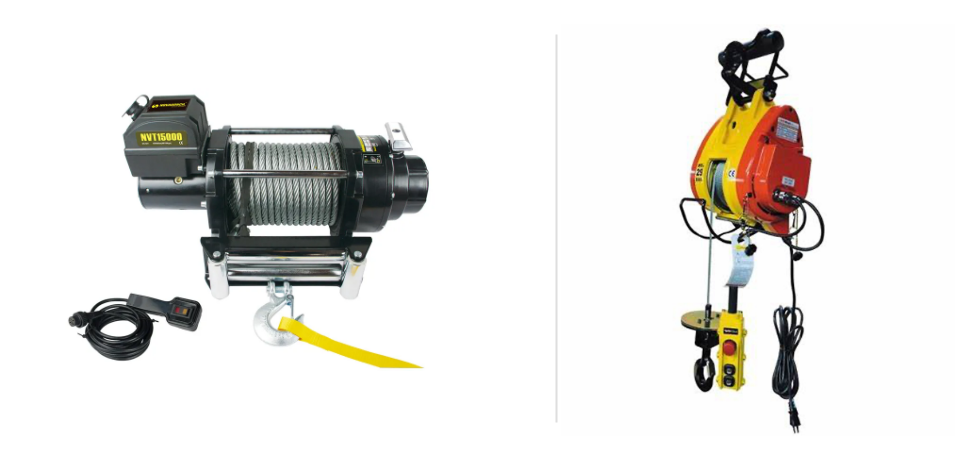
1. Core Functionality
Winches are designed primarily for pulling or dragging loads horizontally—across flat or inclined surfaces.
Hoists are engineered for lifting loads vertically—raising, lowering, or suspending objects.
A useful way to remember:
Winch = Pull. >
Hoist = Lift. ^
2. Position & Installation
Hoists must be positioned directly above the load, typically mounted to beams or overhead supports to lift safely.
Winches can be mounted at a distance—on walls, floors, ground vehicles, or frames—and pull loads via pulley blocks if needed. A benefit: many winches operate via wireless remote (great for safety)!
3. Working Length & Line Type
Winches use cables or wire or synthetic rope wound on a drum, allowing long working lengths, often 15–40 m or more depending on configuration.
Hoists typically use chains or shorter wire lines, supporting 2–20 m, limited by weight, safety, and balance considerations.
4. Brake & Safety Systems
Winches generally feature dynamic braking: resistance created by the geartrain holds the load. This is fine for pulling but not reliable for supporting a suspended load vertically.
Hoists are built with mechanical load brakes and include load-limit switches, specifically designed to lock securely mid‑air, preventing accidental drops.
Can you use a winch as a hoist?
Not unless explicitly designed for it. Standard winches lack a failsafe braking system for lifted loads and could slip, strip gears, creating a serious hazard. Winches have a much lower built in safety ratio (the difference between the rated capacity and the point when it will fail). Only certain winches that include approved locking brakes and no free‑spool mechanism can legally double as hoists — but only if manufacturer certified for that application.
5. Load Capacity & Applications
Hoists are generally rated for heavier loads in vertical lifting scenarios—often hundreds of kilograms, many larger units have built-in overload protection.
Winches usually have broad ratings but are optimized for horizontal pulling tasks, such as vehicle recovery, moving heavy equipment across surfaces, tensioning cables, or anchoring maritime vessels.
6. Power Types & Use
Both winches and hoists are available in manual, electric, or hydraulic, variants
Winches are often more portable: 12 V or 24 V vehicle-mounted units are common, making them ideal for field recovery or situational pulling tasks .
Hoists usually rely on mains‑powered or industrial power sources, designed for precision vertical lifting environments .
Quick Comparison Table
| Winch | Hoist | |
|---|---|---|
| Primary Action | Pull / Drag horizontally | Lift / Lower vertically |
| Installation | Can be remote from load | Mounted directly above load |
| Line Type | Cable or wire rope (long lengths) | Chain or wire rope (shorter range) |
| Working Length | 15 – 40 m (or more) | 2 – 20 m |
| Brake System | Dynamic brake (not load‑holding) | Mechanical brake + load limiter |
| Load Capacity | Wide range, optimized for pulling | High capacity vertical lifting |
| Portability/Power | Often vehicle‑based, wireless | Typically fixed, mains or industrial |
When to Choose What
Use a winch when you need to pull or drag heavy items: vehicle recovery, towing, positioning loads across surfaces or inclines.
Use a hoist when you need to lift, lower, or hold a load suspended in the air: construction, workshop lifting to mezzanines, scaffolding, or industrial material handling.
Never substitute one for the other unless the manufacturer explicitly states a winch or hoist is dual-rated for both vertical lifting and horizontal pulling.